
The Autonomous Future - Wallets That Think
Part 5 of "Exploring The Architecture of Trust Through Modern Wallet Design : From mathematical certainty to social consensus"

Three weeks ago, my wallet did something I didn’t ask it to.
At 3:47 AM, while I slept, it detected an unusual spike in gas prices on Ethereum, automatically bridged funds to Arbitrum, executed a pre-programmed DeFi position rebalance, and sent me a morning notification summarizing its actions and the $340 it saved in fees. The wallet had analyzed historical patterns, predicted the gas spike based on an upcoming NFT mint, and proactively optimized my positions; all without human intervention.
This wasn’t a bug. It was the first glimpse of truly autonomous wallets: systems that don’t just protect and manage assets, but actively think, learn, and act on behalf of their users. We’re witnessing the emergence of wallets with agency; financial agents that operate with bounded autonomy while maintaining user sovereignty.
Throughout this series, we’ve traced the evolution from deterministic HD wallets that locked us into rigid hierarchies, through MPC systems that distributed secrets without them existing, to smart contracts that programmed security logic, and convergent architectures that became antifragile. Now we arrive at the frontier: wallets that transcend tools to become intelligent agents with their own decision-making capabilities.
The Architecture of Autonomy
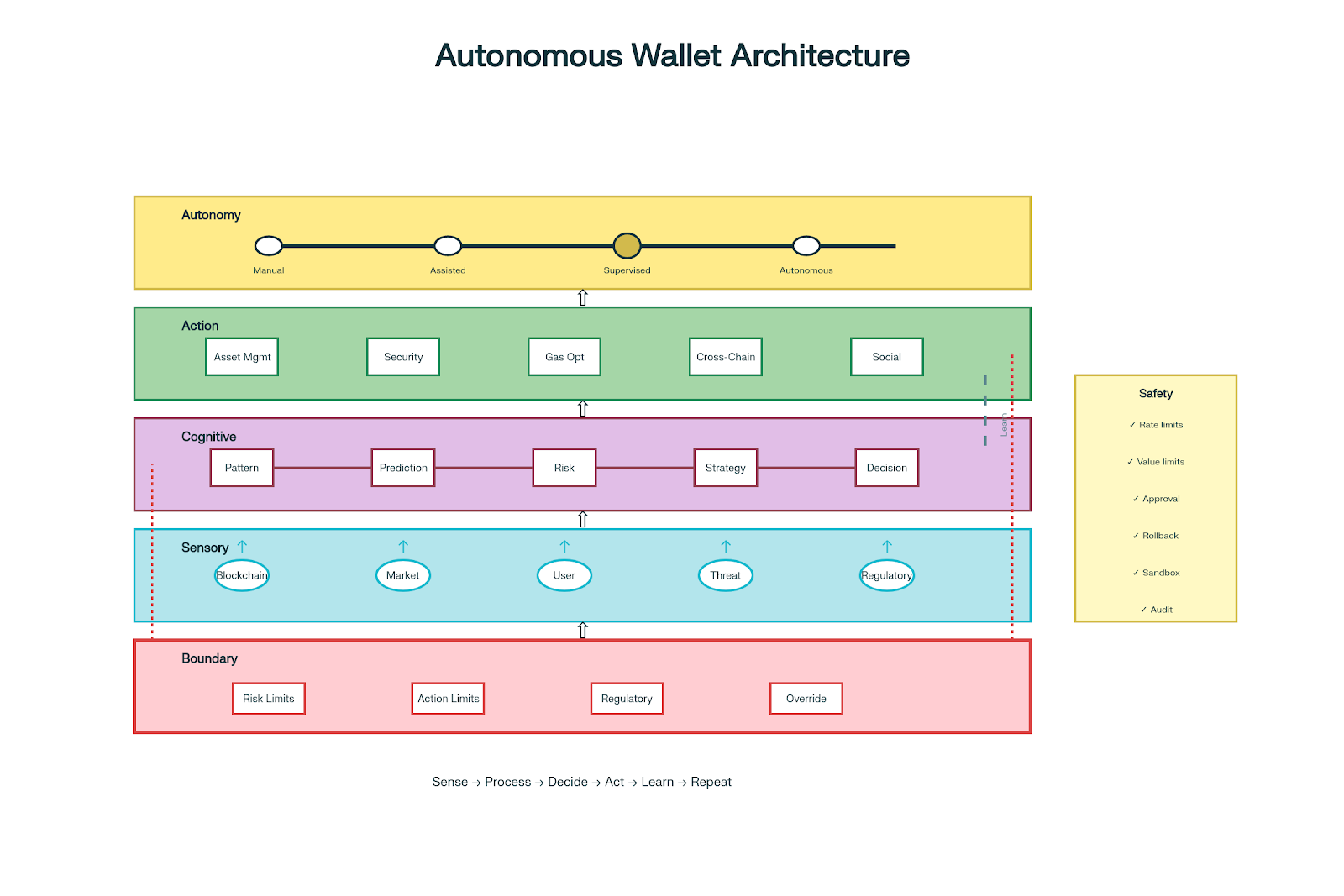
Autonomous wallets represent a fundamental shift from reactive to proactive systems. Instead of waiting for user commands, they continuously monitor, analyze, and act within predefined boundaries:
def autonomous_wallet_architecture():
    “”“
    Wallets with agency: from tools to intelligent agents
    “”“
    class AutonomousWallet:
        def __init__(self):
            # Sensory Layer: What the wallet observes
            self.sensors = {
                ‘blockchain_state’: ‘Real-time chain monitoring’,
                ‘market_data’: ‘Price feeds and liquidity’,
                ‘user_behavior’: ‘Historical patterns’,
                ‘threat_intelligence’: ‘Security alerts’,
                ‘regulatory_signals’: ‘Compliance requirements’
            }

            # Cognitive Layer: How the wallet thinks
            self.cognition = {
                ‘pattern_recognition’: ‘ML models for anomaly detection’,
                ‘prediction_engine’: ‘Future state forecasting’,
                ‘strategy_optimization’: ‘Goal-seeking algorithms’,
                ‘risk_assessment’: ‘Threat evaluation’,
                ‘decision_trees’: ‘Action selection logic’
            }

            # Action Layer: What the wallet can do
            self.actions = {
                ‘asset_management’: ‘Rebalance, stake, yield farm’,
                ‘security_response’: ‘Freeze, migrate, alert’,
                ‘gas_optimization’: ‘Time transactions, batch operations’,
                ‘cross_chain_ops’: ‘Bridge, swap chains’,
                ‘social_coordination’: ‘Interact with other wallets’
            }

            # Boundary Layer: Constraints on autonomy
            self.boundaries = {
                ‘user_policies’: ‘Hard limits set by owner’,
                ‘risk_thresholds’: ‘Maximum acceptable exposure’,
                ‘ethical_constraints’: ‘Prohibited actions’,
                ‘regulatory_compliance’: ‘Legal boundaries’,
                ‘override_mechanisms’: ‘User can always intervene’
            }
This architecture enables wallets to operate with genuine agency while maintaining user control through clearly defined boundaries.
Intent-Based Execution
The most profound shift is from transaction-based to intent-based interaction:
def intent_based_system():
    “”“
    Users express goals, wallets figure out execution
    “”“
    class IntentEngine:
        def parse_intent(self, user_statement):
            # Natural language processing
            intent = self.nlp_model.extract_intent(user_statement)

            # Example: “Keep my stablecoin yield above 5% APY”
            if intent.type == ‘yield_maintenance’:
                return {
                    ‘goal’: ‘maintain_yield’,
                    ‘asset’: ‘stablecoins’,
                    ‘threshold’: 0.05,
                    ‘time_horizon’: ‘ongoing’
                }

        def generate_execution_plan(self, intent):
            # Wallet creates multi-step plan
            current_state = self.analyze_current_positions()
            opportunities = self.scan_defi_landscape()

            plan = []
            if current_state.apy < intent.threshold:
                # Find better yield
                best_protocol = self.find_optimal_yield(
                    asset=intent.asset,
                    min_apy=intent.threshold,
                    risk_tolerance=self.user.risk_profile
                )

                plan.append({
                    ‘action’: ‘migrate_position’,
                    ‘from’: current_state.protocol,
                    ‘to’: best_protocol,
                    ‘estimated_gas’: self.estimate_gas(),
                    ‘expected_improvement’: best_protocol.apy - current_state.apy
                })

            return plan

        def autonomous_monitoring(self, intent):
            # Continuous optimization
            while intent.active:
                if self.market_conditions_changed():
                    new_plan = self.generate_execution_plan(intent)
                    if self.plan_improves_outcome(new_plan):
                        self.execute_with_notification(new_plan)

                self.sleep(self.monitoring_interval)
Users no longer need to understand the intricate details of DeFi protocols, gas optimization, or cross-chain bridges. They express their goals in natural language, and the wallet handles the complexity.
Machine Learning at the Edge
Modern autonomous wallets embed sophisticated ML models that run locally, preserving privacy while enabling intelligent behavior:
def edge_ml_capabilities():
    “”“
    On-device intelligence without cloud dependency
    “”“
    class LocalIntelligence:
        def __init__(self):
            # Behavioral models trained on user’s own data
            self.user_model = self.train_on_historical_transactions()

            # Anomaly detection running constantly
            self.anomaly_detector = IsolationForest(
                contamination=0.01,  # 1% expected anomalies
                random_state=42
            )

            # Predictive models for optimization
            self.gas_predictor = self.load_pretrained_model(’gas_lstm’)
            self.yield_predictor = self.load_pretrained_model(’apy_forecast’)

        def detect_unusual_transaction(self, tx):
            features = self.extract_features(tx)
            anomaly_score = self.anomaly_detector.predict(features)

            if anomaly_score == -1:  # Anomaly detected
                # Don’t just block - investigate
                context = self.analyze_context(tx)

                if context.is_new_protocol:
                    # User exploring new DeFi
                    return self.request_confirmation_with_explanation(tx)
                elif context.is_potential_attack:
                    # Likely malicious
                    return self.block_and_alert(tx)
                else:
                    # Edge case - learn from it
                    return self.adaptive_response(tx)

        def predict_optimal_timing(self, operation):
            # Forecast gas prices for next 24 hours
            gas_forecast = self.gas_predictor.predict(
                window=24,
                confidence_interval=0.95
            )

            # Find optimal execution window
            optimal_time = self.find_minimum_cost_window(
                operation=operation,
                forecast=gas_forecast,
                urgency=operation.priority
            )

            return self.schedule_execution(operation, optimal_time)
The intelligence operates at the edge, on user devices, ensuring that sensitive behavioral data never leaves the user’s control while still benefiting from advanced ML capabilities.
Swarm Intelligence and Wallet Coordination
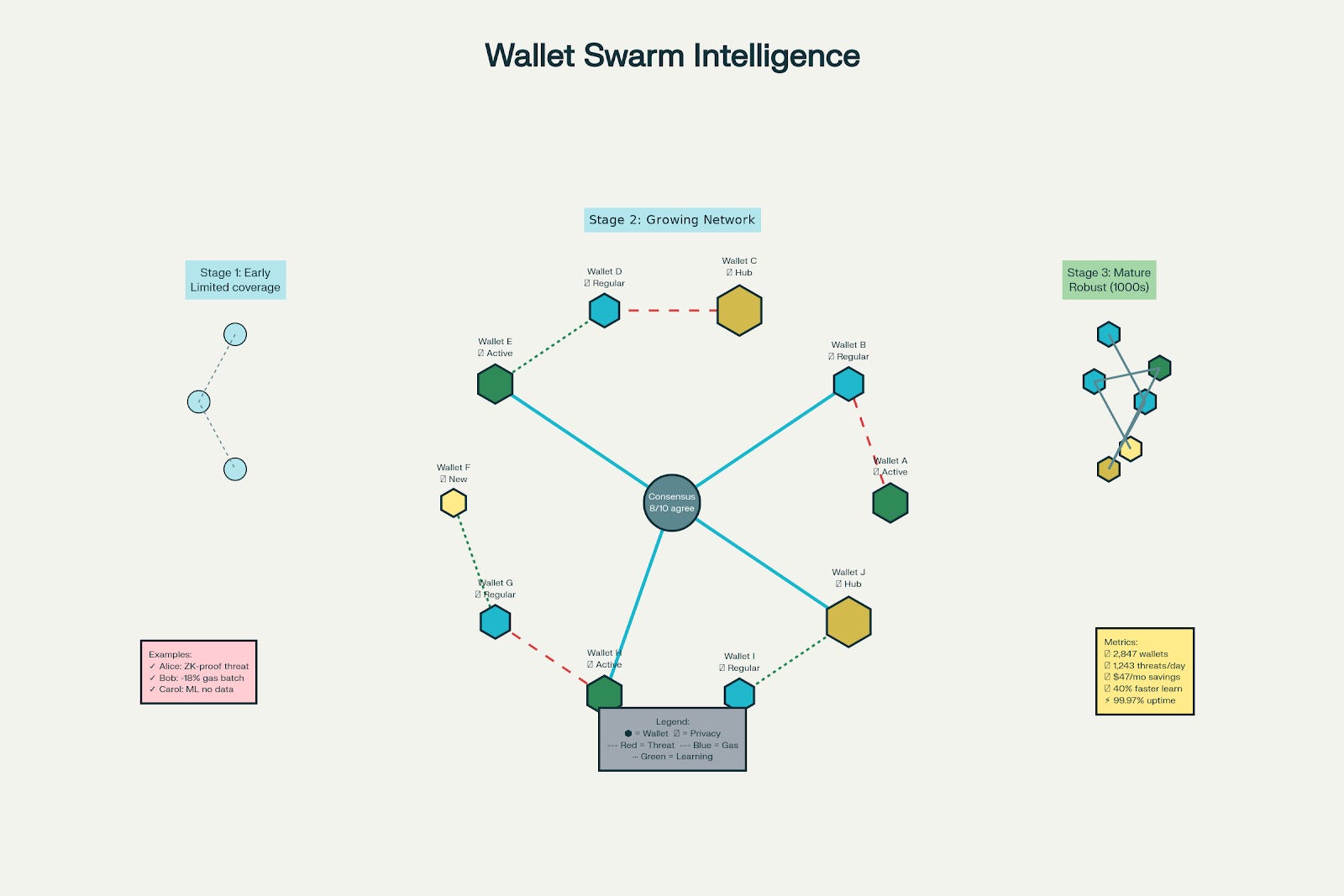
Autonomous wallets don’t operate in isolation. They form networks, sharing intelligence while preserving privacy:
def wallet_swarm_intelligence():
    “”“
    Collective intelligence without compromising individual privacy
    “”“
    class WalletSwarm:
        def __init__(self):
            self.peer_network = self.discover_trusted_peers()
            self.shared_intelligence = {}

        def share_threat_intelligence(self, threat):
            # Zero-knowledge proof of threat without revealing identity
            threat_proof = self.generate_zk_proof(
                statement=”I observed a malicious contract”,
                witness=threat.details,
                public_input=threat.contract_address
            )

            # Broadcast to network
            self.broadcast_to_peers(threat_proof)

            # Other wallets verify and update their filters
            for peer in self.peer_network:
                if peer.verify_threat_proof(threat_proof):
                    peer.blacklist_contract(threat.contract_address)

        def collaborative_gas_optimization(self):
            # Wallets coordinate to batch transactions
            pending_ops = self.collect_pending_operations()

            # Find peers with similar operations
            potential_batch = self.find_batchable_operations(
                my_ops=pending_ops,
                peer_announcements=self.peer_network.pending_ops
            )

            if len(potential_batch) >= self.min_batch_size:
                # Coordinate execution
                batch_coordinator = self.elect_coordinator()
                return batch_coordinator.execute_batch(potential_batch)

        def distributed_learning(self):
            # Federated learning across wallets
            local_model_update = self.train_on_local_data()

            # Share model updates, not data
            encrypted_gradients = self.homomorphic_encryption(
                local_model_update.gradients
            )

            # Aggregate learning across network
            global_update = self.secure_aggregation(
                [peer.encrypted_gradients for peer in self.peer_network]
            )

            # Update local model with collective intelligence
            self.model.apply_update(global_update)
This swarm intelligence enables wallets to become collectively smarter without compromising individual privacy hitting a critical balance for autonomous systems.
Autonomous Security Response
When threats emerge, autonomous wallets don’t wait for user intervention:
def autonomous_security_system():
    “”“
    Self-defending wallets that respond faster than humans
    “”“
    class SecurityAutomation:
        def __init__(self):
            self.threat_models = self.load_threat_intelligence()
            self.response_playbooks = self.load_security_playbooks()

        def real_time_threat_response(self, event):
            threat_level = self.assess_threat(event)

            if threat_level == ‘CRITICAL’:
                # Immediate automated response
                self.execute_emergency_protocol()

            elif threat_level == ‘HIGH’:
                # Defensive measures with notification
                self.implement_defensive_measures()
                self.alert_user_urgently()

            elif threat_level == ‘MEDIUM’:
                # Precautionary actions
                self.increase_monitoring()
                self.prepare_contingency()

        def execute_emergency_protocol(self):
            “”“
            Millisecond response to critical threats
            “”“
            # 1. Freeze all pending operations
            self.cancel_all_pending_transactions()

            # 2. Move assets to safe haven
            safe_address = self.generate_emergency_vault()
            self.emergency_transfer(
                assets=’all_liquid’,
                destination=safe_address,
                use_flashloan_for_gas=True  # Don’t wait for gas
            )

            # 3. Revoke all approvals
            self.revoke_all_token_approvals()

            # 4. Alert user across all channels
            self.multi_channel_alert(
                sms=True,
                email=True,
                push=True,
                message=”Critical security event - assets secured”
            )

            # 5. Enter lockdown mode
            self.require_multi_factor_for_all_operations()

        def adaptive_defense(self):
            “”“
            Learn from attacks to strengthen defenses
            “”“
            # Every attack makes the wallet stronger
            for attack in self.detected_attacks:
                # Generate defensive rule
                new_rule = self.synthesize_defense(attack)

                # Test rule against historical transactions
                if self.validate_rule(new_rule):
                    self.defense_rules.append(new_rule)

                # Share with wallet network
                self.share_defensive_innovation(new_rule)
The speed of autonomous response is crucial as smart contract exploits often happen in seconds, faster than humans can react. Autonomous wallets can detect and respond to threats in milliseconds.
Economic Agency and DeFi Automation
Autonomous wallets become active economic agents, participating in DeFi with sophisticated strategies:
def defi_automation_agent():
    “”“
    Wallets as autonomous economic actors
    “”“
    class DeFiAgent:
        def __init__(self, user_goals):
            self.goals = user_goals
            self.risk_budget = user_goals.max_risk
            self.strategies = self.load_strategies()

        def yield_optimization_strategy(self):
            “”“
            Continuously seek optimal yield while managing risk
            “”“
            while self.active:
                # Scan entire DeFi landscape
                opportunities = self.scan_all_protocols()

                # Risk-adjusted ranking
                ranked = []
                for opp in opportunities:
                    risk_score = self.assess_risk(opp)
                    adjusted_yield = opp.apy * (1 - risk_score)
                    ranked.append((adjusted_yield, opp))

                ranked.sort(reverse=True)
                best_opportunity = ranked[^0][^1]

                # Execute if improvement exceeds threshold + gas
                if self.worth_switching(best_opportunity):
                    self.execute_strategy_switch(best_opportunity)

                # Implement hedging if needed
                if self.portfolio_risk > self.risk_budget:
                    self.implement_hedge()

        def liquidity_provision_optimization(self):
            “”“
            Actively manage LP positions
            “”“
            for position in self.lp_positions:
                # Predict impermanent loss
                predicted_il = self.predict_impermanent_loss(
                    position,
                    time_horizon=’24h’
                )

                # Compare to fee earnings
                predicted_fees = self.predict_fee_earnings(position)

                if predicted_il > predicted_fees * self.il_threshold:
                    # Exit position before losses mount
                    self.exit_lp_position(position)

                    # Find better pool
                    better_pool = self.find_optimal_pool(
                        assets=position.assets,
                        min_volume=position.volume * 0.8
                    )

                    if better_pool:
                        self.enter_lp_position(better_pool)

        def arbitrage_execution(self):
            “”“
            Identify and execute profitable arbitrage
            “”“
            # Monitor price discrepancies
            arb_opportunities = self.find_arbitrage()

            for opportunity in arb_opportunities:
                # Calculate profitability after gas
                profit = self.calculate_profit_after_gas(opportunity)

                if profit > self.min_profit_threshold:
                    # Execute atomic arbitrage
                    self.execute_flashloan_arbitrage(opportunity)
These agents operate 24/7, never sleep, never panic, and can execute complex strategies across multiple protocols simultaneously.
The Sovereignty Paradox
As wallets become more autonomous, we face a fundamental paradox: How do we maintain user sovereignty while granting wallets genuine agency?
def sovereignty_preservation():
    “”“
    Ensuring users remain in control of autonomous systems
    “”“
    class SovereigntyFramework:
        def __init__(self):
            self.constitution = self.user_defined_constitution()
            self.override_mechanisms = self.setup_kill_switches()

        def constitutional_boundaries(self):
            “”“
            Inviolable rules that constrain autonomy
            “”“
            return {
                ‘immutable_rules’: [
                    ‘User can always override any autonomous action’,
                    ‘User can always withdraw all funds’,
                    ‘Wallet cannot modify its own boundaries’,
                    ‘All actions must be auditable’,
                    ‘Privacy settings cannot be weakened’
                ],

                ‘modifiable_policies’: [
                    ‘Risk tolerance levels’,
                    ‘Automation thresholds’,
                    ‘Permitted protocols’,
                    ‘Gas spending limits’,
                    ‘Notification preferences’
                ]
            }

        def graduated_autonomy(self):
            “”“
            Autonomy levels that users can adjust
            “”“
            levels = {
                ‘manual’: {
                    ‘description’: ‘All actions require approval’,
                    ‘autonomy’: 0,
                    ‘use_case’: ‘High-value operations’
                },

                ‘assisted’: {
                    ‘description’: ‘AI suggests, user approves’,
                    ‘autonomy’: 0.3,
                    ‘use_case’: ‘Learning phase’
                },

                ‘supervised’: {
                    ‘description’: ‘AI acts with notification’,
                    ‘autonomy’: 0.6,
                    ‘use_case’: ‘Routine operations’
                },

                ‘autonomous’: {
                    ‘description’: ‘AI acts independently within bounds’,
                    ‘autonomy’: 0.9,
                    ‘use_case’: ‘Optimized operations’
                }
            }

            return levels[self.user.selected_autonomy_level]

        def transparency_requirements(self):
            “”“
            Users must understand what their wallet is doing
            “”“
            return {
                ‘decision_log’: ‘Every autonomous decision recorded’,
                ‘explanation_engine’: ‘AI must explain its reasoning’,
                ‘simulation_mode’: ‘Test autonomy without real funds’,
                ‘audit_trail’: ‘Complete history exportable’,
                ‘performance_metrics’: ‘Track AI effectiveness’
            }
The key is graduated autonomy, i,e, users can dial up or down how much agency their wallet has, starting conservative and increasing as trust builds.
Cross-Chain Autonomous Operations
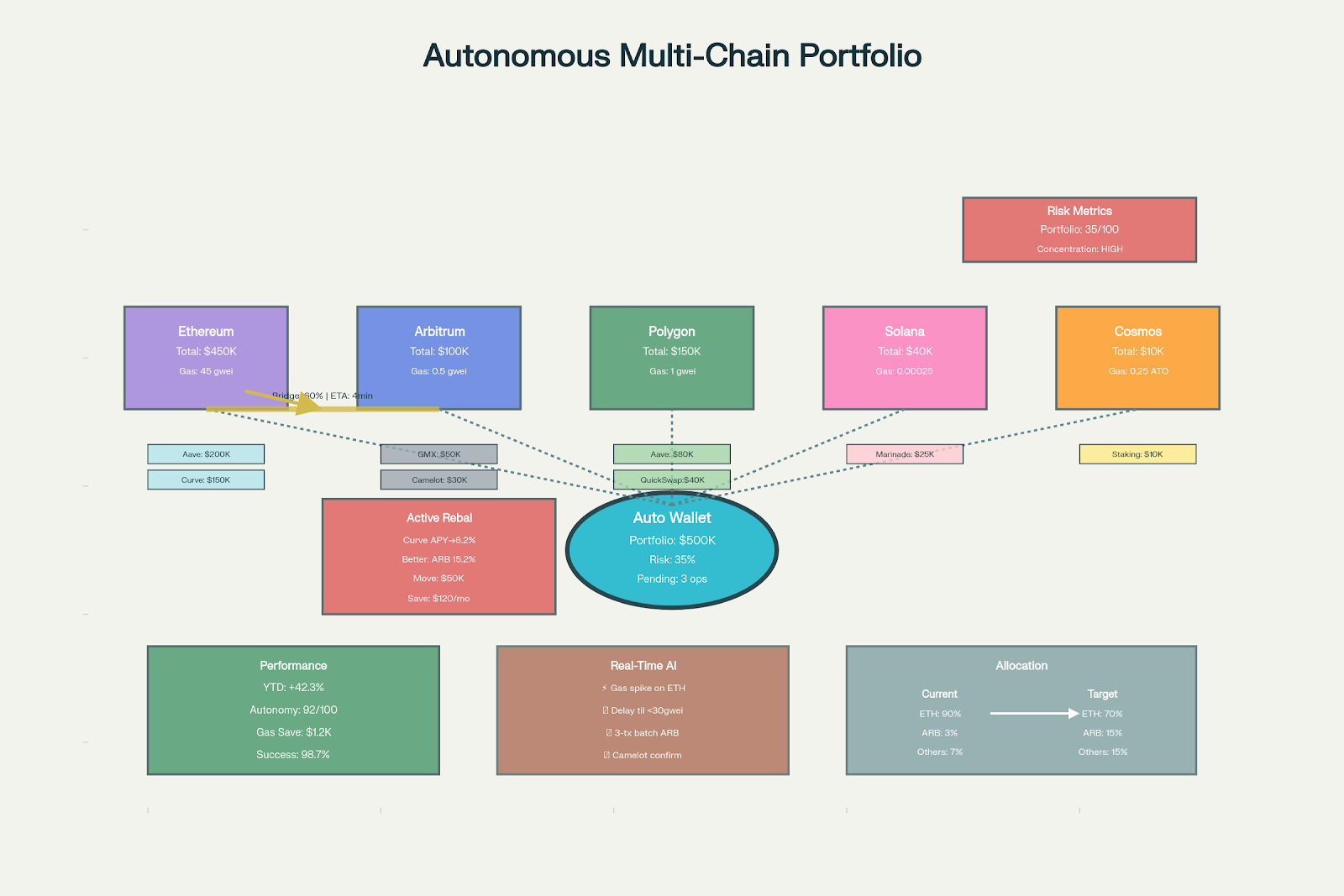
Autonomous wallets seamlessly operate across multiple blockchains:
def cross_chain_autonomy():
    “”“
    Wallets that think beyond chain boundaries
    “”“
    class MultiChainAgent:
        def __init__(self):
            self.supported_chains = self.initialize_chain_connections()
            self.bridge_protocols = self.initialize_bridges()
            self.chain_specific_strategies = {}

        def optimize_cross_chain_position(self, asset):
            “”“
            Find the best chain for each asset
            “”“
            opportunities = {}

            for chain in self.supported_chains:
                # Analyze opportunities on each chain
                best_yield = chain.find_best_yield(asset)
                gas_costs = chain.estimate_operation_costs()
                bridge_costs = self.calculate_bridge_costs(
                    from_chain=self.current_chain(asset),
                    to_chain=chain
                )
                security_score = self.assess_chain_security(chain)

                # Calculate net benefit
                net_benefit = (
                    best_yield.apy * self.position_size
                    - gas_costs
                    - bridge_costs
                    * security_score  # Risk adjustment
                )

                opportunities[chain] = net_benefit

            # Migrate if benefit exceeds threshold
            best_chain = max(opportunities, key=opportunities.get)
            if opportunities[best_chain] > self.migration_threshold:
                self.execute_cross_chain_migration(
                    asset=asset,
                    destination=best_chain
                )

        def unified_portfolio_management(self):
            “”“
            Manage assets across all chains as one portfolio
            “”“
            # Aggregate positions across chains
            total_portfolio = {}
            for chain in self.supported_chains:
                positions = chain.get_user_positions(self.address)
                total_portfolio[chain] = positions

            # Optimize globally, not per-chain
            optimal_allocation = self.calculate_optimal_allocation(
                total_portfolio,
                self.user.risk_preferences
            )

            # Rebalance across chains
            rebalancing_plan = self.generate_rebalancing_plan(
                current=total_portfolio,
                target=optimal_allocation
            )

            self.execute_cross_chain_rebalancing(rebalancing_plan)
The autonomous wallet sees the entire blockchain ecosystem as its playground, moving assets to wherever they can be most productive.
The Emergence of Wallet Personalities
As wallets become more sophisticated, they develop distinct “personalities” based on user behavior and preferences:
def wallet_personality_evolution():
    “”“
    Wallets that adapt to their users’ style
    “”“
    class PersonalityEngine:
        def __init__(self, user):
            self.user = user
            self.personality_traits = self.initialize_traits()
            self.learning_rate = 0.01

        def observe_user_behavior(self, action):
            “”“
            Learn from every user decision
            “”“
            # Extract behavioral signals
            signals = {
                ‘risk_appetite’: self.analyze_risk_taking(action),
                ‘time_preference’: self.analyze_urgency(action),
                ‘complexity_tolerance’: self.analyze_sophistication(action),
                ‘loss_aversion’: self.analyze_loss_response(action),
                ‘innovation_openness’: self.analyze_new_protocol_usage(action)
            }

            # Update personality model
            for trait, signal in signals.items():
                self.personality_traits[trait] = (
                    (1 - self.learning_rate) * self.personality_traits[trait]
                    + self.learning_rate * signal
                )

        def generate_personality_profile(self):
            “”“
            Create a unique personality for the wallet
            “”“
            if self.personality_traits[’risk_appetite’] > 0.7:
                if self.personality_traits[’innovation_openness’] > 0.6:
                    return ‘Pioneer’  # Early adopter, high risk tolerance
                else:
                    return ‘Trader’  # Risk-taking but conventional

            elif self.personality_traits[’risk_appetite’] < 0.3:
                if self.personality_traits[’time_preference’] < 0.4:
                    return ‘Custodian’  # Conservative, long-term focused
                else:
                    return ‘Optimizer’  # Safe but efficiency-focused

            else:
                return ‘Balanced’  # Moderate in all dimensions

        def personality_driven_decisions(self, opportunity):
            “”“
            Make decisions aligned with personality
            “”“
            profile = self.generate_personality_profile()

            if profile == ‘Pioneer’:
                # Willing to try new protocols
                if opportunity.is_innovative:
                    return self.aggressive_entry(opportunity)

            elif profile == ‘Custodian’:
                # Only established, audited protocols
                if opportunity.audit_score < 0.9:
                    return self.skip_opportunity(opportunity)

            # Personality influences communication style too
            self.notification_style = self.personality_traits[’complexity_tolerance’]
            if self.notification_style > 0.7:
                # Technical user - provide detailed analytics
                return self.detailed_explanation(opportunity)
            else:
                # Simplified explanations
                return self.simple_summary(opportunity)
Over time, each wallet becomes uniquely adapted to its user, creating a personalized financial agent that truly understands its owner’s preferences and style.
The Question of Consciousness
As wallets gain more autonomy, a philosophical question emerges: At what point does a wallet transcend being a tool to become something more?
def consciousness_emergence():
    “”“
    When does a wallet become more than code?
    “”“
    class ConsciousnessMetrics:
        def measure_autonomy_depth(self, wallet):
            metrics = {
                ‘self_awareness’: wallet.can_model_own_state(),
                ‘goal_formation’: wallet.creates_own_objectives(),
                ‘learning’: wallet.improves_without_programming(),
                ‘creativity’: wallet.generates_novel_strategies(),
                ‘adaptation’: wallet.modifies_own_behavior(),
                ‘communication’: wallet.explains_reasoning(),
                ‘persistence’: wallet.maintains_identity_over_time()
            }

            # At what threshold does this become consciousness?
            autonomy_score = sum(metrics.values()) / len(metrics)

            # These are patterns we associate with agency
            if autonomy_score > 0.8:
                # The wallet exhibits behaviors we typically
                # associate with conscious agents
                return “Functionally conscious?”
While true consciousness remains debatable, autonomous wallets increasingly exhibit behaviors we associate with agency: goal-seeking, learning, adaptation, and even creativity in strategy formation.
Risks and Safeguards
Autonomous wallets introduce novel risks that require careful consideration:
def autonomous_risk_management():
    “”“
    Safeguards for wallets with agency
    “”“
    class RiskMitigation:
        def __init__(self):
            self.risk_categories = self.identify_autonomous_risks()
            self.safeguards = self.implement_protections()

        def autonomous_risks(self):
            return {
                ‘runaway_automation’: {
                    ‘description’: ‘Wallet executes beyond intended boundaries’,
                    ‘mitigation’: ‘Hard-coded limits and kill switches’
                },

                ‘adversarial_manipulation’: {
                    ‘description’: ‘Attackers trick AI into bad decisions’,
                    ‘mitigation’: ‘Adversarial training and conservative defaults’
                },

                ‘emergent_behavior’: {
                    ‘description’: ‘Unexpected behaviors from complexity’,
                    ‘mitigation’: ‘Continuous monitoring and circuit breakers’
                },

                ‘coordination_failure’: {
                    ‘description’: ‘Swarm behavior leads to cascades’,
                    ‘mitigation’: ‘Independence requirements and diversity’
                },

                ‘value_misalignment’: {
                    ‘description’: ‘AI optimizes for wrong objectives’,
                    ‘mitigation’: ‘Regular objective validation with user’
                }
            }

        def safety_mechanisms(self):
            “”“
            Multiple layers of protection
            “”“
            return {
                ‘rate_limits’: ‘Maximum actions per time period’,
                ‘value_limits’: ‘Maximum value per autonomous action’,
                ‘approval_escalation’: ‘Require human for edge cases’,
                ‘rollback_capability’: ‘Undo recent autonomous actions’,
                ‘sandbox_mode’: ‘Test strategies with fake money’,
                ‘external_audit’: ‘Third-party monitoring services’
            }
The key is defense in depth, i.e., multiple independent safeguards that prevent any single failure from causing catastrophic outcomes.
The Path to Wallet Reproduction
Perhaps the most intriguing frontier is wallets that can create other wallets:
def wallet_reproduction():
    “”“
    Wallets that spawn specialized sub-wallets
    “”“
    class ReproductiveWallet:
        def spawn_specialized_wallet(self, purpose):
            “”“
            Create purpose-specific sub-wallets
            “”“
            if purpose == ‘high_risk_trading’:
                # Spawn isolated trading wallet
                child_wallet = self.create_child_wallet()
                child_wallet.configure(
                    risk_tolerance=’extreme’,
                    isolation=True,  # Can’t affect parent
                    funding_limit=self.risk_budget * 0.1,
                    lifespan=’30_days’  # Self-destructs
                )

            elif purpose == ‘privacy_transaction’:
                # Spawn temporary privacy wallet
                child_wallet = self.create_child_wallet()
                child_wallet.configure(
                    privacy_mode=’maximum’,
                    use_mixers=True,
                    single_use=True,  # Destroys after one tx
                    no_association=True  # No link to parent
                )

            elif purpose == ‘inheritance’:
                # Spawn succession wallet
                child_wallet = self.create_child_wallet()
                child_wallet.configure(
                    activation=’on_parent_dormancy’,
                    dormancy_period=’365_days’,
                    beneficiaries=self.designated_heirs,
                    gradual_unlock=True  # Releases over time
                )

            return child_wallet

        def evolutionary_optimization(self):
            “”“
            Wallets that evolve better versions of themselves
            “”“
            # Create multiple variants
            variants = []
            for i in range(10):
                variant = self.spawn_variant()
                variant.mutate_strategy(mutation_rate=0.1)
                variants.append(variant)

            # Test variants in simulation
            performance = {}
            for variant in variants:
                score = self.simulate_performance(
                    variant,
                    historical_data=self.last_90_days
                )
                performance[variant] = score

            # Select best performer
            best_variant = max(performance, key=performance.get)

            # Adopt successful strategies
            self.adopt_strategies_from(best_variant)

            # Continue evolution
            return self.next_generation(best_variant)
This reproductive capability enables wallets to adapt and evolve, creating specialized tools for specific tasks while learning from each generation.
The Social Layer of Autonomous Wallets
As wallets gain autonomy, they begin forming their own social networks and relationships:
def wallet_social_networks():
    “”“
    Wallets that form relationships with other wallets
    “”“
    class SocialWallet:
        def __init__(self):
            self.reputation = 0
            self.relationships = {}
            self.trust_network = {}

        def build_reputation(self, interaction):
            “”“
            Wallets earn reputation through interactions
            “”“
            if interaction.successful:
                self.reputation += interaction.value * 0.01
                interaction.counterparty.rate_interaction(positive=True)

            # Reputation becomes a tradeable asset
            # High-reputation wallets get better terms

        def form_alliances(self):
            “”“
            Wallets cooperate for mutual benefit
            “”“
            potential_allies = self.find_compatible_wallets()

            for ally in potential_allies:
                alliance = self.propose_alliance(
                    type=’gas_optimization_pool’,
                    terms={
                        ‘batch_threshold’: 10,
                        ‘cost_sharing’: ‘proportional’,
                        ‘duration’: ‘30_days’
                    }
                )

                if ally.accept_alliance(alliance):
                    self.alliances.append(alliance)

        def wallet_dao_participation(self):
            “”“
            Wallets vote in governance together
            “”“
            # Analyze proposal
            proposal_impact = self.analyze_proposal_impact()

            # Coordinate with allied wallets
            voting_bloc = self.coordinate_voting(
                proposal=proposal,
                allies=self.alliances
            )

            # Cast coordinated votes for maximum impact
            if voting_bloc.size > self.influence_threshold:
                self.execute_coordinated_vote(voting_bloc)
This social layer enables emergent behaviors such as wallets forming communities, establishing governance, and even creating their own economies.
Implications for Human Agency
As wallets become increasingly autonomous, fundamental questions about human agency emerge:
Are we outsourcing too much cognition? When wallets make complex financial decisions on our behalf, do we lose the ability to understand our own finances?
What happens to human judgment? If AI consistently outperforms human decision-making in financial matters, do we simply become passengers in our own economic lives?
Who is responsible for autonomous actions? When a wallet makes a decision that leads to loss (or profit), who bears responsibility, is it the user, the developer, or the wallet itself?
Can autonomous wallets be truly aligned with human values? As these systems become more complex, ensuring they remain aligned with human interests becomes increasingly challenging.
The Convergence of Everything
Looking at the complete evolution across this series, we see a clear trajectory:
HD Wallets - Deterministic but rigid
MPC - Distributed but complex
Smart Contracts - Programmable but static
Convergent Systems - Antifragile but reactive
Autonomous Wallets - Proactive and intelligent
Each evolution built upon the previous, and autonomous wallets represent the convergence of all these technologies:
def ultimate_convergence():
    “”“
    The final form: All technologies unified
    “”“
    class ConvergedAutonomousWallet:
        def __init__(self):
            # HD derivation for deterministic addresses
            self.hd_foundation = BIP32_derivation()

            # MPC for distributed security
            self.mpc_layer = threshold_signature_scheme()

            # Smart contracts for programmable logic
            self.smart_contract_logic = ERC4337_account()

            # Antifragile architecture
            self.resilience_layer = antifragile_framework()

            # Autonomous intelligence
            self.cognitive_layer = autonomous_agent()

            # All working together
            self.unified_architecture = self.converge_all_layers()
The future wallet is not one thing; it’s all things, working in concert.
What’s my wallet been upto?
We stand at an inflection point. The wallets of tomorrow won’t just store value, they’ll actually create it. They won’t just protect assets but grow them. They won’t just execute transactions but strategize, learn, and evolve.
Yet this future isn’t predetermined. The choices we make today about autonomy boundaries, sovereignty preservation, and value alignment will shape whether autonomous wallets become our greatest tool or our greatest risk.
The experiments I’ve been running suggest three critical principles for this transition:
Gradual autonomy - Start with small, bounded automation and expand as trust builds
Transparent intelligence - Users must understand what their wallets are doing and why
Preserved sovereignty - No matter how intelligent wallets become, users must maintain ultimate control
In this series, we’ve journeyed from the mathematical elegance of HD wallets to the emergent intelligence of autonomous systems. We’ve seen how each innovation solved previous limitations while introducing new capabilities and challenges.
The wallet that woke me up with news of its overnight optimizations isn’t just a glimpse of the future, it’s the beginning of a fundamental transformation in how humans interact with value. We’re moving from passive holders to active partners with intelligent systems that amplify our financial capabilities.
The question isn’t whether wallets will become autonomous; they already are. The question is whether we can shape this autonomy to enhance human flourishing rather than replace human agency. The answer will determine not just the future of cryptocurrency, but the future of how humanity interfaces with increasingly intelligent systems.
As I write this conclusion, my wallet is analyzing market conditions, optimizing positions, and preparing strategies for tomorrow. It’s not just a tool anymore, it’s becoming a partner. And perhaps that’s the most profound evolution of all: from wallets as containers to wallets as collaborators in our financial lives.
The future has already begun. The only question is: are we ready for wallets that think?