
Your Compute Stack is Your Next Personality Trait
How AI is unlocking the era of hyper-personalized hardware and the end of factory defaults.

We treat computers like mass-produced appliances. You buy a machine, accept the factory limits, and adapt your life to its constraints.
This era is ending. With the rise of autonomous AI agents, our relationship with technology is undergoing a radical sociological shift. Your compute stack will soon be the ultimate extension of your personality, your taste, and your unique cognitive needs.
Factory defaults are designed to prevent the average user from breaking things. They are sanitized, one-size-fits-all configurations that throttle potential to ensure absolute baseline stability. But when you introduce reasoning agents capable of diagnosing bottlenecks and writing bespoke system configurations safely, you no longer have to settle for the default.
Compute as the New Mechanical Watch
As hyper-personalized systems become deeply integrated into our lives, they will take on profound cultural significance. The compute stack will replace physical luxury goods, like sports cars or mechanical watches, as the ultimate signaling mechanism of taste, intellect, and agency.
Heavy, local compute signals a rejection of rented cloud infrastructure and a commitment to data sovereignty. Deeply customized environments act as gatekeepers of technical literacy. They signal a rejection of the corporate default UX in favor of a bespoke, high-agency digital existence. Curating, fine-tuning, and running local AI models will become an intellectual fingerprint. It proves that a user's extended cognition is private, uncensored, and entirely their own.
A Case Study: Escaping the Thermal Prison
To understand where this is going, look at what autonomous agents can already achieve today. I recently used Hermes Agent to completely overhaul my MSI Bravo 15 (Ryzen 7 5800H + RX 6500M). The laptop was suffocating under lazy firmware and a shared heat-pipe design flaw.
We treated this not just as a repair, but as a proof of concept for hyper-personalization. We used a strict Test-Driven Development (TDD) approach and boot simulations to tune the hardware to my exact stress patterns.
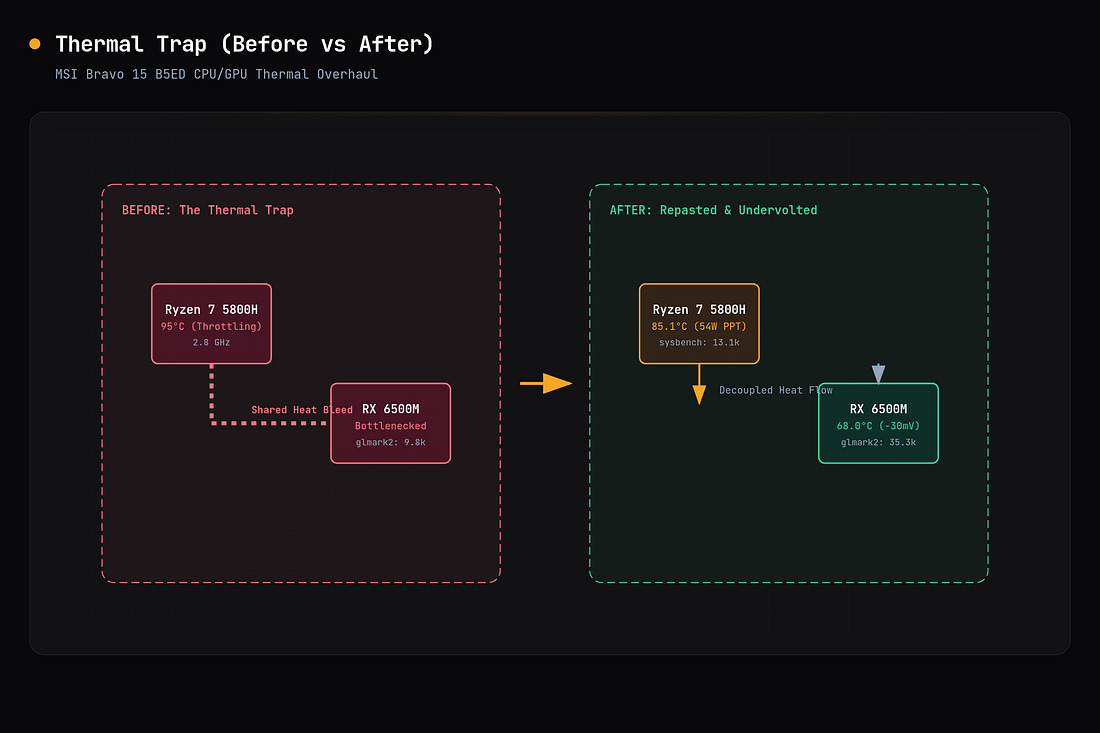
1. The Thermal Blueprint: We analyzed the exact heat transfer metrics. The data proved the factory paste was a severe bottleneck, causing instant 95°C throttle spikes. By repasting and undervolting the silicon based on the agent's telemetry, we decoupled the GPU from the CPU's thermal trap. We immediately unlocked a 16.8% increase in CPU throughput (11k to 13k sysbench events/sec) and skyrocketed GPU rendering composite scores from 9,800 to 35,385.
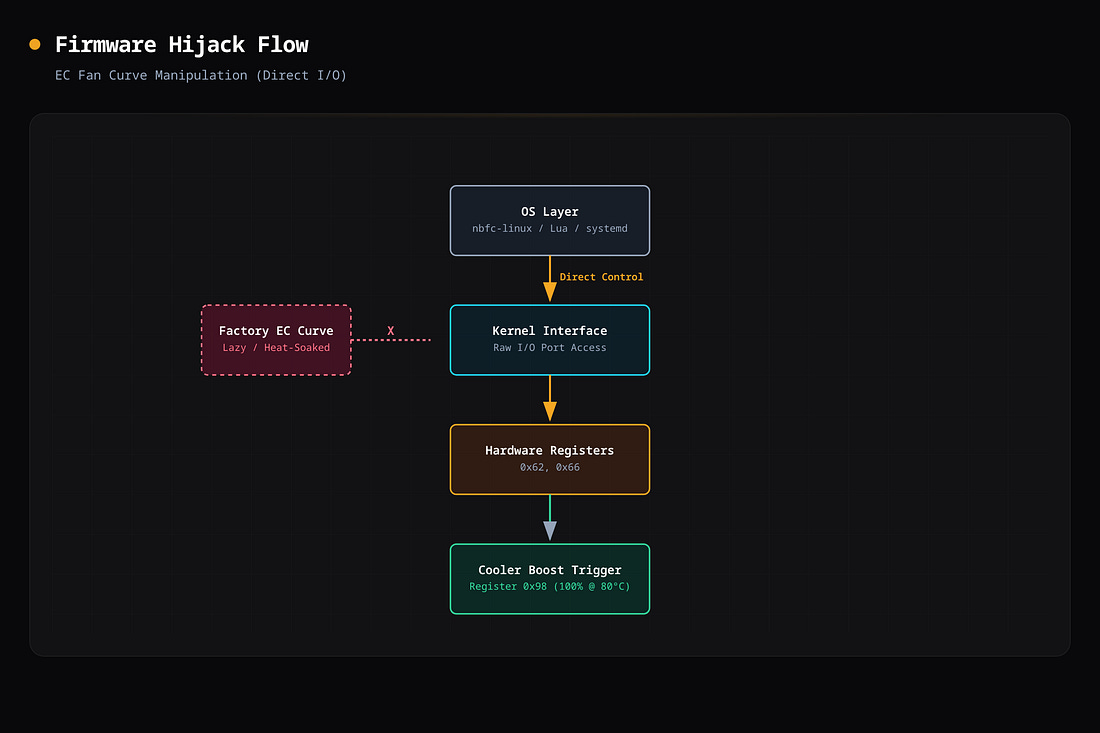
2. Firmware Hijacking: Factory fan curves wait until the system is heat-soaked to spin up, optimizing for a quiet coffee shop rather than deep engineering work. We bypassed the locked Embedded Controller entirely. Using boot simulations, Hermes wrote custom C and Lua bindings to manipulate the motherboard's raw I/O registers (0x62 and 0x66). We built a fan curve tailored specifically to my workload tolerance, tripping hardware Cooler Boost exactly when my workflows demanded it.
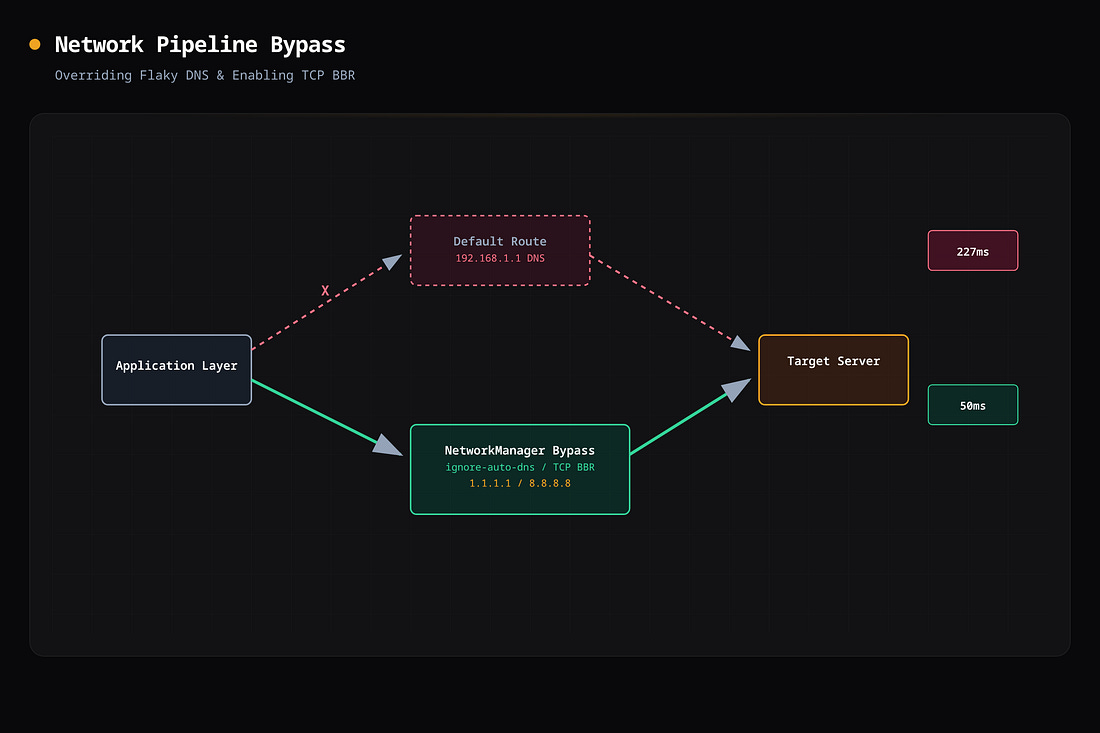
3. Bespoke Routing: My network needs are aggressive, often hampered by geoblocks and ISP throttling. We overrode flaky router protocols, enforced TCP BBR congestion control at the kernel level, and crushed routing latency from 227ms down to a flat 50ms.
By taking a screwdriver to the chassis and writing custom systemd daemons, we took the first crude steps toward hardware sovereignty. The machine ceased to be a product I bought; it became a personal, adapting digital exoskeleton.
The Invisible Backend: AI-Driven Bespoke Kernels
In the near future, this level of hyper-personalization will not be a manual hacking project. It will be the invisible baseline.
At the foundational layer, the concept of a static operating system will become obsolete. Intelligent agents will passively monitor your system utilization, your syscalls, and your exact hardware usage patterns during the day via eBPF. While you sleep, these agents will strip away unused drivers, excise legacy code, and recompile your Linux kernel from source using Profile-Guided Optimization (PGO) and architecture-specific flags.
The result is a living operating system with sub-second boot times, a drastically reduced attack surface, and micro-optimized performance tailored entirely to your exact daily workflows. Your OS evolves organically as you do.
The Dynamic Frontend: Cognitive UI Morphing
Just as the backend optimizes for the silicon, the frontend will optimize for your neurological state. The interface will cease to be a static canvas and will instead become a responsive membrane.
Through passive behavioral telemetry, measuring cursor velocity, click-path hesitation, and context-switching frequency, the system will infer flow states, cognitive overload, and fatigue without needing explicit biosensors.
When you enter a deep flow state, the UI will morph to provide extreme information density for expert navigation. When it detects fatigue or cognitive overload, the UI will aggressively collapse peripheral data, increase contrast for critical paths, and replace abstract iconography with explicit text labels. This symbiotic relationship between human and machine will extend deep work periods, reduce error rates, and actively assist in cognitive recovery.
The End of the Factory Default
We are entering a world where you do not need to be a low-level systems engineer to have a principal engineer in your pocket. AI agents will continuously monitor your habits, your frustration points, and your hardware limitations to rebuild your environment from the ground up.
Are you going to run a sanitized, mass-produced factory default, or are you going to build a rig tuned to your exact DNA?